
Note-taking competes with listening
Agents either type during the call and half-listen, or promise to write it up later and forget. Either way the record is thin, and the next person to call the client starts from nothing.
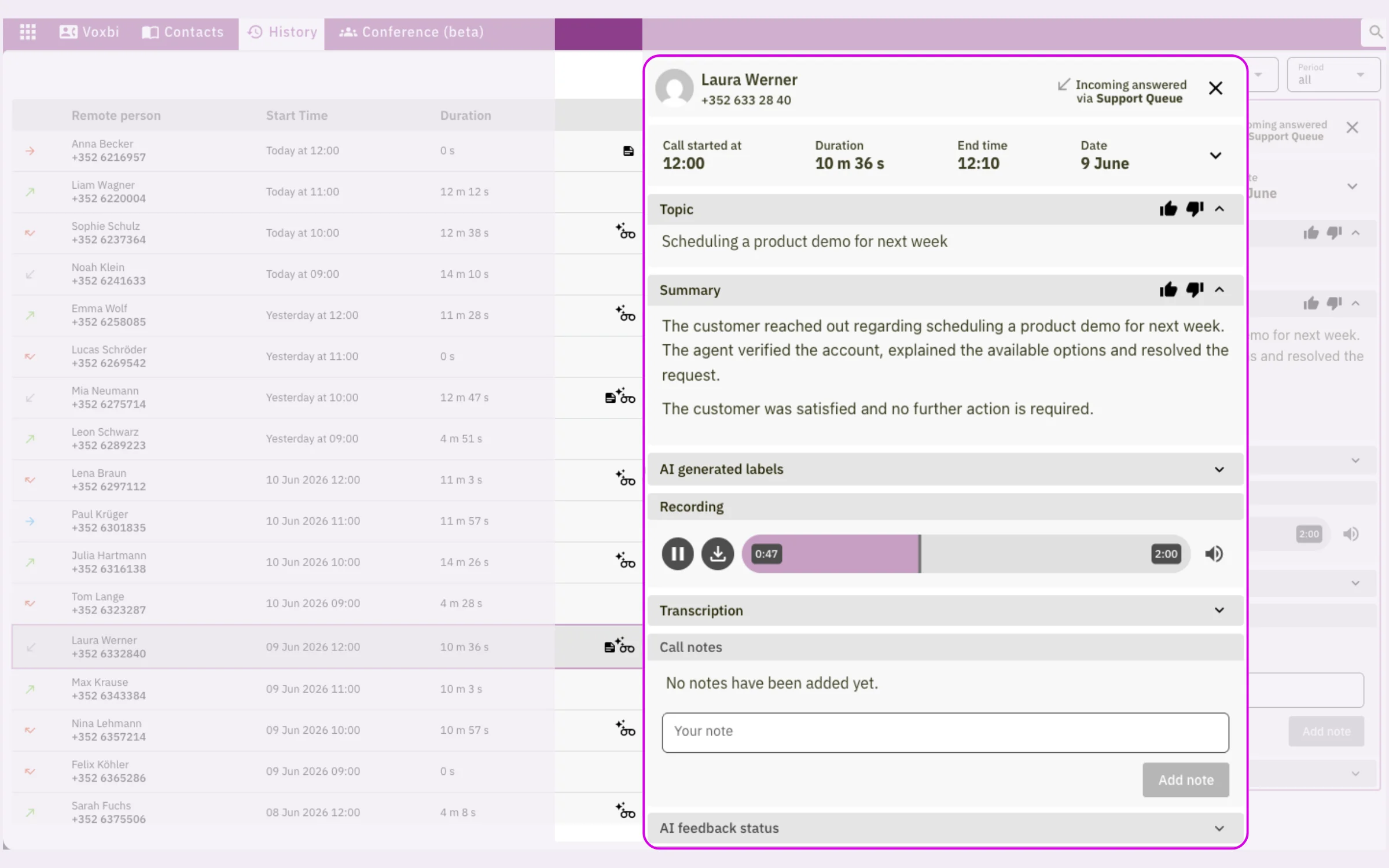
Voxbi turns each business call into a written transcript and a short summary with the key points, decisions, and follow-up actions, automatically after the call ends. No manual note-taking, and the audio and text are processed in EU data centres under GDPR and the EU AI Act.
Agents either type during the call and half-listen, or promise to write it up later and forget. Either way the record is thin, and the next person to call the client starts from nothing.
A recording answers 'what was said' only if someone listens to the whole call again. For a quick check or a dispute, replaying minutes of audio to find one line is not realistic.
Call audio and transcripts are personal data. Bolt-on tools often process them on US servers, which leaves your clients in LU, FR, BE, and DE explaining a transfer they never wanted to their compliance team.
Call Insights summarises and tags every call inside the Voxbi dashboard, next to your analytics. Most teams read the structured summary (key points, decisions, follow-up actions) and open the full transcript only for a deeper review. Both are searchable across your whole call history.
Once consent is confirmed at the start of the call, Voxbi captures the audio. Recording and transcription are part of the same cloud PBX, so there is nothing extra to wire up.
AI transcribes the audio within minutes and labels each speaker where it can tell them apart. The result is a searchable, verbatim record of the conversation.
A second model reads the transcript and pulls out the key points, what was decided, and who owns each follow-up action, so most people only need to read the summary.
The transcript and summary are saved to the Voxbi dashboard and can be pushed into your CRM through the API, so the contact record updates without anyone copying and pasting.
Verbatim text with speaker labels and timestamps, searchable across your entire call history. Find every call where a client name, product, or topic came up without replaying any audio.
A short bullet list of what the caller asked, what was discussed, and what matters most, so a colleague can pick up the relationship in seconds.
A clear record of what was agreed, who owns each action, and the follow-up date. The part that usually lives only in someone's memory, written down.
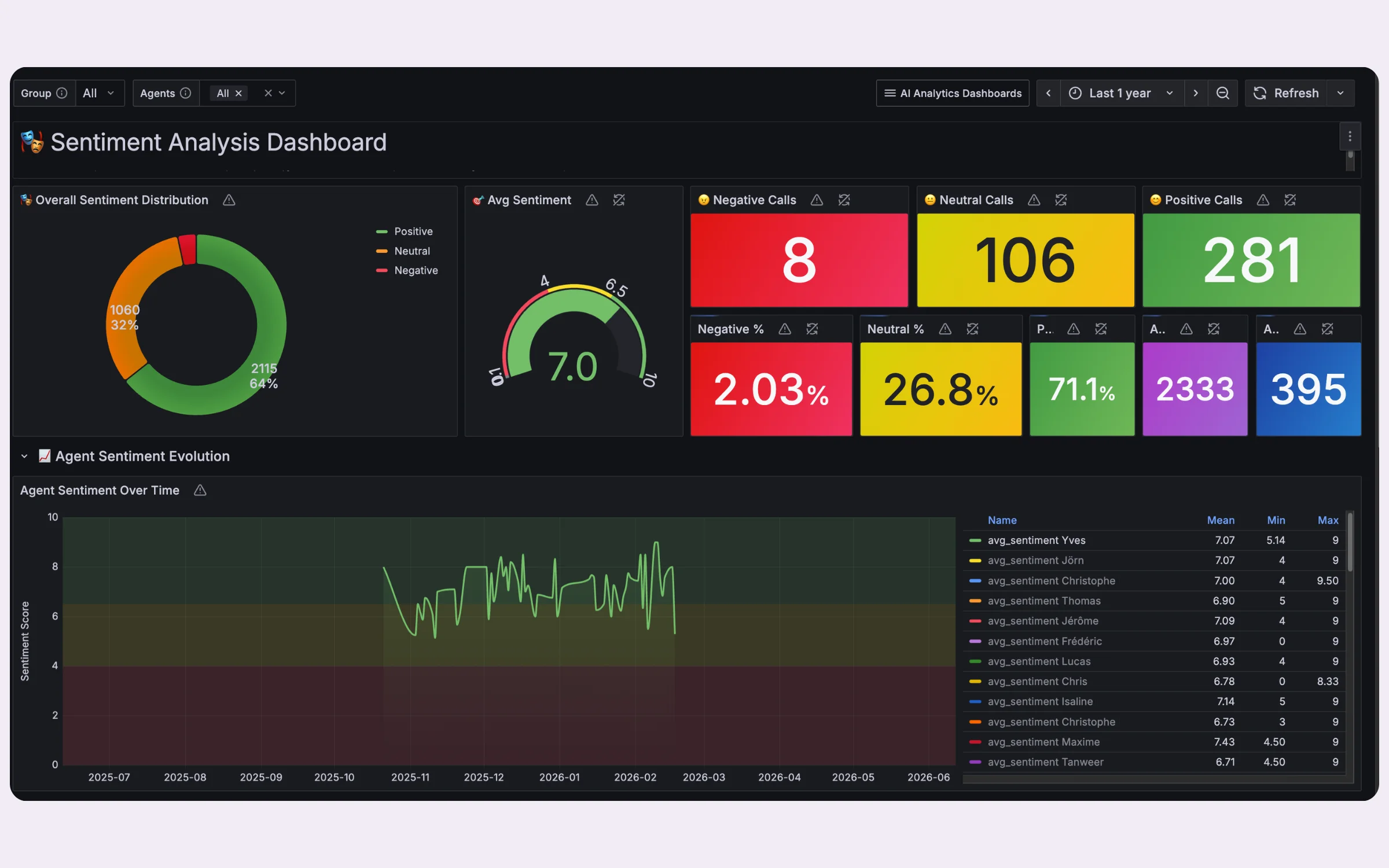
Flag trigger words like refund, cancel, urgent, or complaint so a supervisor can review the right calls instead of sampling at random.
Every call is summarised and tagged automatically, so you can track recurring topics across the team and spot trends without reading each conversation.
Load your product names, place names, and industry terms into a custom dictionary. Generic models stumble on jargon; a vocabulary list lifts accuracy sharply on specialist calls.
Good call notes are the difference between a client who feels remembered and one who has to repeat themselves.
No note-taking during the conversation and no write-up afterwards. Agents focus on the customer, not the keyboard, and still leave a complete record behind.
Every word is captured and searchable, keyword alerts catch the critical phrases, and disputes are settled with an objective record instead of two conflicting memories.
Whoever picks up the next call has the full context, answers line up across agents, and commitments made on a call are visible to the whole team.
Plenty of tools transcribe a call. The questions that matter are where your data is processed and whether the result reaches your systems on its own.
Voxbi is very user-friendly for end users, while still letting us implement more advanced configurations centrally.
We have been able to expand across the entire European Union and even internationally without ever worrying about communication costs or technical constraints.
Audio and transcripts are personal data. For businesses in LU, FR, BE, and DE, processing in EU data centres is the practical standard under GDPR, and the EU AI Act adds duties on top. Ask exactly where the audio goes.
English, French, and German are well supported across modern models. Luxembourgish is still the weakest link in most tools, so check coverage against the languages your team actually uses, including calls that switch language midway.
Product names, place names, and jargon break generic models. The ability to load a custom dictionary is what raises accuracy on the calls that matter most to you.
The summary should land in the contact record on its own. If you have to copy and paste it, you lose most of the time you were trying to save over writing notes by hand.
For most calls the transcript and summary are ready within one to three minutes of the call ending. You read the summary first and open the full transcript only when you need a deeper review.
Yes. Transcripts are stored in a searchable index, so you can find every call where a specific client, product, or topic was mentioned without listening to any recordings. You can filter by agent, date, and queue on top of keyword search.
Yes, both are supported at strong accuracy alongside English. Luxembourgish has limited support across all vendors today, so verify the language list with us if your team works mainly in one language or switches language within a single call.
Audio and transcripts are processed and stored in EU data centres, so they stay under GDPR and the EU AI Act rather than being sent outside the EU. That keeps the data-residency answer simple for your clients and their compliance teams.
Access is controlled by role in the admin settings. A typical setup lets managers see their team's transcripts while agents see only their own. Define and document your access policy to meet GDPR accountability, and review it whenever someone changes role or leaves.
For most standard sales and support calls, yes. The AI summary covers what an agent would write by hand, and it pushes into the contact record automatically. In regulated work where notes are evidence, treat the AI output as a draft for human review rather than a final record.
Start a free trial and watch a real call turn into a transcript and summary in minutes. No credit card required.